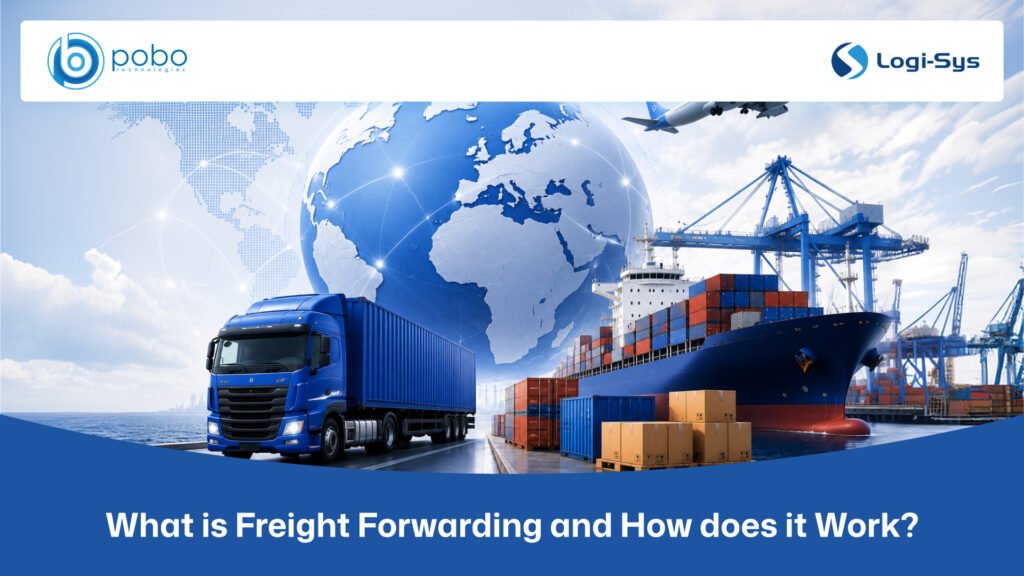
Moving goods from one country to another involves more than choosing a carrier and arranging transportation. Each shipment requires coordination between shippers, carriers, customs authorities, warehouses, transport providers, and consignees.
Freight forwarding integrates these activities into a single managed process. It enables businesses to move cargo more efficiently by coordinating transportation, documentation, customs clearance, handling, tracking, and final delivery from origin to destination.
What is Freight Forwarding?
Freight forwarding is the coordination and management of cargo movement between locations on behalf of a shipper.
A freight forwarder is a logistics specialist who plans shipments, reserves cargo space with carriers, prepares shipping documents, coordinates customs clearance, arranges inland transportation, and monitors cargo from origin to final delivery.
Freight forwarding can facilitate ocean, air, road, rail, and multimodal transportation. The exact service is determined by the cargo type, shipment size, delivery timeline, destination, regulatory requirements, and the customer’s commercial needs.
How does Freight Forwarding Work?
Although the exact workflow varies depending on the cargo, route, transport mode, customs requirements, and agreed-upon service terms, the freight-forwarding process typically consists of six major stages.
Export Haulage
The process begins with the pickup of goods from the shipper’s factory, warehouse, or business location.
The freight forwarder arranges for transportation from the pickup location to the origin warehouse, port, airport, terminal, or container freight station. This initial inland movement is typically completed by road, but rail or another appropriate mode of transportation may also be used.
Before collection, the forwarder confirms the pickup time, vehicle specifications, cargo readiness, and delivery instructions.
Origin Handling and Cargo Verification
Once the cargo reaches the origin facility, it is checked against the booking details.
The freight forwarder or handling team verifies the quantity of packages, weight, dimensions, labels, supporting documentation, and cargo condition. Any discrepancies between the physical cargo and the booking information must be identified and resolved before the shipment can proceed.
Depending on the mode of transportation and the shipment requirements, the cargo may be packed, palletized, consolidated, labeled, or loaded into a container.
Export Customs Clearance
Before the cargo can leave the country of origin, all necessary export customs procedures must be completed.
The freight forwarder may coordinate this process with a licensed customs broker or an authorized internal customs team. Export declarations and supporting documents are submitted to the appropriate customs authority.
Commercial invoices, packing lists, transport documents, certificates of origin, export permits, and other commodity-specific approvals may all be required. The documentation requirements vary depending on the cargo, destination, and applicable regulations.
Incorrect or incomplete documentation can result in delays, customs inquiries, and other clearance issues. The cargo can only be moved once the necessary export formalities have been completed.
Main Carriage and Transit
Following export clearance and origin handling, the cargo is loaded onto the appropriate vessel, aircraft, truck, or train for the main mode of transport.
The freight forwarder monitors the shipment and keeps track of key milestones such as departure, transshipment, estimated arrival, actual arrival, and potential delays.
Throughout the transit period, the forwarder communicates with carriers, overseas agents, terminals, and the customer to keep shipment information current.
If there is a delay, routing change, missed connection, or documentation issue, the freight forwarder coordinates the response and notifies the appropriate parties.
Import Customs Clearance
When the cargo arrives in the destination country, it must go through the required import customs procedures before being released.
The freight forwarder or nominated customs broker submits import documents, calculates applicable duties and taxes, responds to customs inquiries, and coordinates inspections as needed.
The specific requirements depend on the cargo type, declared value, country of origin, tariff classification, destination regulations, and commercial terms.
Once customs clearance is complete and all applicable duties, taxes, and charges have been paid, the cargo is released for destination handling.
Import Haulage and Final Delivery
Following release, the freight forwarder arranges for the final inland movement from the destination port, airport, terminal, or warehouse to the consignee.
The forwarder manages destination handling, delivery scheduling, transportation arrangements, cargo release, and any necessary documentation.
Once the cargo arrives, proof of delivery is collected, shipment records are updated, costs are confirmed, and the job is ready for final billing and closure.
Freight forwarding encompasses numerous departments, documents, service providers, customer updates, and financial transactions. When these processes are managed using spreadsheets, emails, or disconnected systems, teams may encounter duplicate work, delays in updates, and limited visibility.
To address these challenges, freight forwarders use an ERP system such as Logi-Sys.
Logi-Sys is one of the ERP software solutions that helps freight forwarding operations run smoothly. It combines freight management, customs, warehousing, transportation, billing, accounting, AI-powered intelligence, and system integrations into a unified cloud platform. This allows freight forwarders to manage operations on land, sea, and air while connecting teams, branches, partners, and financial processes through a common database.
Benefits of Freight Forwarding
Freight forwarding allows businesses to efficiently transport goods across borders by managing complex logistics activities. It can help to reduce costs through shipment consolidation and negotiated rates, save time by handling documentation and customs coordination, and ensure compliance with changing trade regulations.
Freight forwarders also help to mitigate risk by recommending appropriate transportation routes, providing access to established global networks, and improving documentation accuracy to avoid costly delays.
Their flexibility enables businesses to respond quickly to last-minute changes, resulting in smoother and more reliable cargo movement from origin to destination.
Conclusion
Freight forwarding is a coordinated process that links transportation, customs clearance, documentation, cargo handling, tracking, delivery, and financial activities from origin to destination.
Freight forwarders make the process easier by serving as the primary link between shippers, carriers, customs authorities, warehouses, and consignees. However, managing each stage using separate tools can result in delays, duplicate work, and limited visibility.
Logi-Sys ERP enables freight forwarders to integrate these activities within a single cloud-based platform. By combining operations, finance, documentation, customer communication, and reporting, teams can work more efficiently and maintain greater control over each shipment.
Pobo Technologies provides Logi-Sys implementation, integration, customization, optimization, training, and ongoing support to help freight forwarders get more out of their ERP system.
Are you ready to improve your freight forwarding operations with Logi-Sys ERP? Schedule a free consultation with Pobo Technologies to discuss your business needs.