A freight forwarder may manage hundreds of shipments across different customers, carriers, countries, branches, and transport modes. Each shipment generates quotations, bookings, freight documents, customs information, milestone updates, supplier costs, customer invoices, and accounting entries.
When this information is managed through separate systems, spreadsheets, emails, and applications, teams often repeat the same data entry. Operations may have one shipment status, customer service may have another, and finance may not receive the final costs on time.
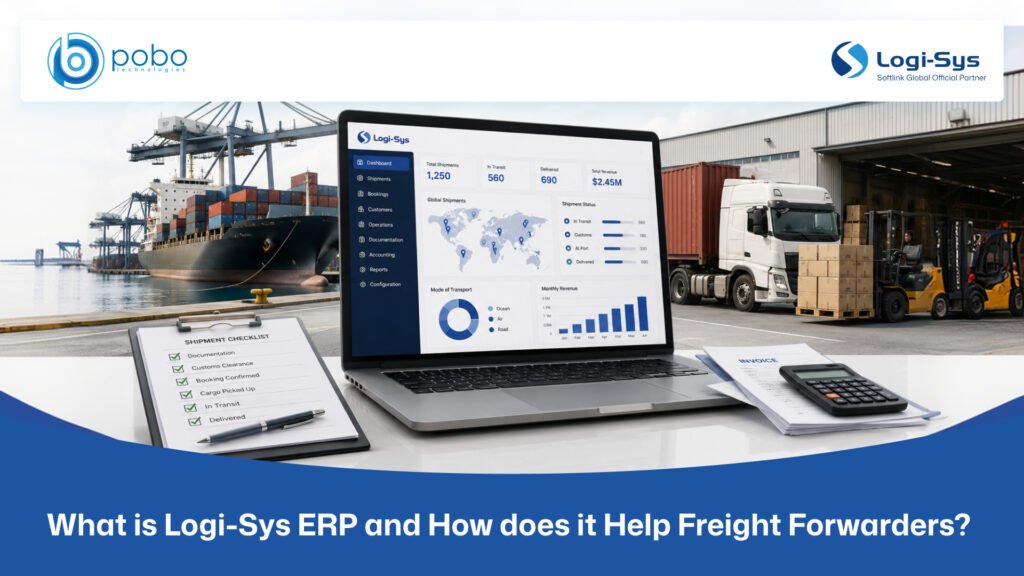
Logi-Sys ERP is designed to connect these activities through one logistics-focused platform.
What is Logi-Sys ERP?
Logi-Sys is an intelligent, cloud-based ERP platform created by Softlink Global for freight forwarders, customs brokers, consolidators, 3PL providers, transportation companies, warehouse operators, and other logistics service providers.
Unlike a general ERP, which requires extensive customization to understand freight processes, Logi-Sys is built around logistics workflows. It combines freight operations, sales, customer service, customs compliance, transportation, warehousing, invoicing, and financial accounting in a single database. It is capable of handling air, ocean, road, and multimodal freight operations.
Its overall capabilities include:
- Freight Forwarding Operations
- Customer quotations and CRM
- Air and ocean documentation
- Customs compliance
- Local transportation
- Warehouse operations
- Purchase-order management
- CFS and AFS operations
- Customer invoicing
- Financial accounting
- Business intelligence
- AI-powered document processing
- Customer visibility
- Carrier connectivity
Instead of each department maintaining its own version of the shipment, authorized teams can work with shared information.
Why do Freight Forwarders Require Specialized Logistics ERP?
Freight forwarding does not involve a single transaction between a shipper and a carrier. A shipment goes through several connected stages:
- Customer inquiry
- Rate request and quotation
- Booking confirmation
- Pickup planning
- Freight documentation
- Customs clearance
- Main carriage
- Shipment tracking
- Arrival coordination
- Final delivery
- Customer billing
- Supplier-cost verification
- Financial closure
A delay or change in one stage can have far-reaching consequences. A revised vessel departure, for example, could affect documentation deadlines, arrival planning, customs coordination, delivery arrangements, and customer communication.
A specialized logistics ERP connects these stages, ensuring that operational changes are reflected throughout the relevant workflows. This allows freight forwarders to maintain greater control as shipment volumes, branches, customers, and service offerings increase.
How does Logi-Sys Support the Complete Shipment Lifecycle?
The Logi-Sys workflow can start before a shipment is scheduled.
Sales teams can record the customer’s inquiry, generate a quote, and follow up on the opportunity. When the customer confirms the shipment, the necessary information can be entered into freight operations.
Operations teams can then create jobs, manage bookings, prepare freight documents, track milestones, coordinate customs activity, and arrange transportation or warehousing. Customer service representatives can use the same shipment information to provide updates.
Once operational services are completed, charges can be moved to invoicing and financial accounting.
Management can then evaluate revenue, costs, outstanding balances, and profitability. This connected lifecycle eliminates the need to duplicate customer, shipment, and charge information at each stage.
What Core Modules Does Logi-Sys ERP Include?
Logi-Sys manages various aspects of the logistics business using interconnected modules. Companies can customize Logi-Sys with the relevant modules to meet their service and operational requirements while keeping data connected across the platform.
Freight Forwarding
The Logi-Sys Freight Forwarding module supports inbound and outbound air and ocean freight operations.
For air freight, teams can manage:
- Air Waybills and House Air Waybills
- Airline bookings and flight schedules
- Direct, back-to-back, and consolidated shipments
- Airline commissions and incentives
- e-AWB and AES processes
- Domestic and international movements
For ocean freight, the module supports:
- Bills of Lading and House Bills of Lading
- Vessel schedules
- Container tracking
- FCL and LCL shipments
- Consolidations
- Freight rates and charge schedules
- AMS, AES, and ISF requirements
The same operational information can support shipment documents, customer updates, billing, accounting, and reporting. Teams do not have to maintain separate job records for each department.
Invoicing
A completed freight job may include ocean or air freight, origin handling, customs services, transport, warehousing, documentation, and destination charges. Every applicable service must be billed accurately.
The Logi-Sys Invoicing module connects billing with freight forwarding, customs, transportation, and warehouse activities.
It supports:
- Direct invoice posting from operations
- Multi-currency invoicing
- Multiple invoice and bill types
- Debit and credit notes
- Tax and e-invoice requirements
- User-configurable invoice formats
- Brokerage and transportation billing
- Unbilled job reports
- Billing registers and MIS reports
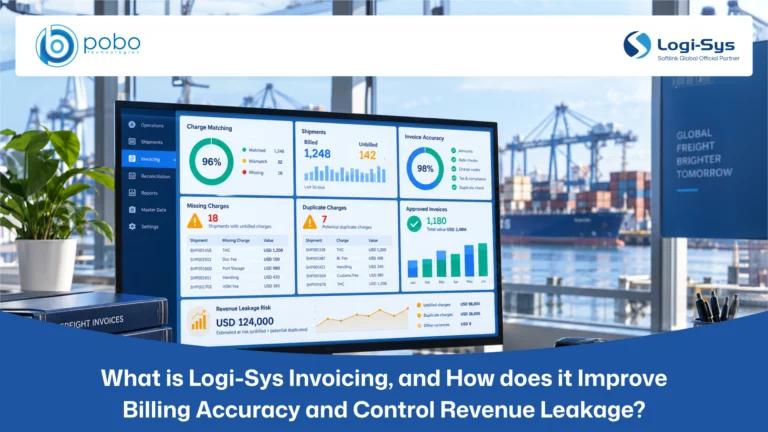
Because billing is connected to operational jobs, finance teams can identify completed services that have not yet been invoiced. This helps reduce missed revenue and makes job closure more controlled.
Financial Accounting
Freight businesses need more than a standalone billing tool. They must manage customer receivables, supplier payables, cash flow, credit limits, foreign currencies, taxes, accruals, and shipment profitability.
The Logi-Sys Financial Accounting module connects financial transactions to the shipment, branch, customer, service, currency, and operational event that generated them.
It includes:
- Accounts receivable and payable
- Cash and bank management
- Multi-company and multi-branch accounting
- Multi-currency transactions
- Shipment-level revenue and cost tracking
- Work-in-progress and accrual management
- Revenue recognition
- Credit control and ageing
- Bank and account reconciliation
- Approval workflows
- Financial-period locking
- Audit trails
- Consolidated reporting
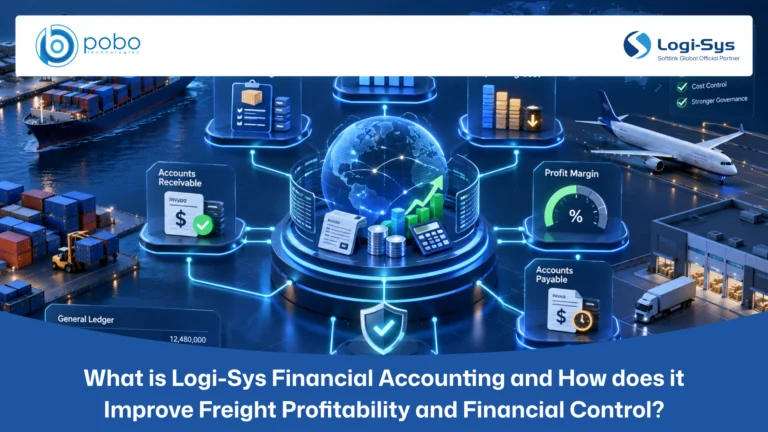
Management can analyze profitability by shipment, customer, branch, mode, service, or trade lane. This helps identify jobs with missing costs, customers with overdue payments, or services with weak margins.
Sales and CRM
Freight operations begin with a customer requirement. Before a shipment is booked, the sales team must understand the opportunity, obtain rates, prepare a quotation, and complete follow-ups.
The Logi-SysSales and CRM module helps logistics companies manage:
- Leads and inquiries
- Customer and prospect information
- Opportunities
- Tariffs and rates
- Quotations
- Sales follow-ups
- Marketing campaigns and budgets
- Customer interactions
- Service requests
- Salesperson performance
- Customer acquisition and retention
When a customer accepts a quotation, the relevant commercial information can move into the operational process. This improves coordination between sales and operations and helps ensure that the service delivered reflects what was quoted.
Customs Compliance for India
Indian customs processes involve bills of entry, shipping bills, supporting documents, classifications, taxes, duties, and electronic filing requirements.
The Logi-Sys Customs Compliance module for India supports:
- Manual and electronic Bills of Entry
- Export Shipping Bills
- Direct filing through ICEGATE
- E-Sanchit supporting documents
- Customs shipment registration
- Electronic invoice imports
- Duty and tax calculations
- Shipment classification
- Filing-status tracking
- Customs reports
Its integration with freight operations allows teams to reuse relevant shipment data during clearance. This reduces repeated entry between the forwarding job and the customs workflow.
Customs Compliance for the USA
US imports and exports require specific electronic manifest, security, and export submissions.
The Logi-Sys Customs Compliance module for the USA provides support for:
- Automated Export System submissions
- Export data validation
- Internal Transaction Number association
- Automated Manifest System declarations
- Importer Security Filing
- ISF 10+2 requirements
- Field validation
- Error detection before submission
- Electronic customs communication
Built-in validations can help users identify incomplete or incorrect fields before transmission, reducing preventable filing errors.
Transportation Management
Freight forwarders frequently coordinate first-mile pickup, container movement, local transport, and final delivery. These activities must remain connected to the main freight job.
The Logi-Sys Transportation Management module supports:
- Pickup and delivery planning
- Trip and route planning
- Driver, vehicle, and trailer allocation
- Container-leg management
- Vehicle inventory
- Fleet management
- Real-time trip updates
- Vehicle tracking
- Electronic proof of delivery
- Transport costs and billing
Mobile capabilities allow drivers and transport teams to receive job information and update trip progress from the road. Operations and customer-service teams can then access more current delivery information.
Warehouse Management
When cargo enters a warehouse, logistics providers need to know its quantity, location, condition, ownership, and next planned movement.
The Logi-Sys Warehouse Management module supports the movement of cargo from receipt to storage and dispatch.
It includes:
- Advanced Shipment Notices
- Goods receipt
- Bay and storage allocation
- Single and multi-warehouse operations
- Inventory visibility
- Barcode and QR code scanning
- Picking and packing
- Repacking
- Goods dispatch
- Customer-owned inventory
- Warehouse billing
- Customer visibility
Warehouse information can connect with freight, transportation, and financial workflows. This allows teams to coordinate cargo movement and billing without maintaining an isolated warehouse record.
Purchase Order Management
Some logistics providers manage shipments in accordance with customer purchase orders. They must keep track of what was ordered, what has been shipped, and what is still pending.
The Logi-Sys Purchase Order Management module supports:
- Purchase-order recording
- PO-to-shipment association
- Order-quantity tracking
- Balance-quantity monitoring
- Dispatch and delivery updates
- Multiple POs within one shipment
- Purchase-order visibility
- Operational reporting
The module is particularly relevant for buyers’ consolidation and vendor-management operations, where several orders may be combined into one freight movement.
Freight Station Management
Container Freight Stations (CFS) and Air Freight Stations (AFS) must coordinate cargo receipt, handling, storage, customs processes, consolidation, and release.
The Logi-Sys Freight Station module supports:
- CFS and AFS operations
- Cargo loading and unloading
- Consolidation and deconsolidation
- Short-term storage
- Customs documentation
- Repacking
- Quality checks
- Cargo release
- Coordination with airlines and ground transport
- Operational and financial tracking
This brings freight-station activities into the wider logistics workflow instead of treating them as disconnected handling events.
How do the Logi-Sys Modules Work Together?
The main advantage of Logi-Sys is not simply that it provides multiple modules. Its value comes from connecting information across sales, operations, customs, transportation, warehousing, customer service, invoicing, and accounting.
Consider an ocean import shipment:
- The sales team records the customer inquiry, prepares a quotation, and confirms the agreed rates.
- The freight operations team creates the booking and shipment job using the confirmed customer and quotation information.
- The documentation team manages the Bill of Lading, arrival details, and other required shipment documents.
- The customs team uses the relevant shipment and document information to prepare and manage clearance.
- The transportation team arranges container collection from the port and plans the delivery.
- If storage is required, the warehouse team records the cargo receipt, storage location, handling activities, and dispatch.
- Throughout the shipment, customer service monitors milestones and communicates relevant updates to the customer.
- Operations records applicable charges, while finance verifies supplier costs and prepares the customer invoice.
- Accounting records revenue, costs, receivables, payables, and shipment profitability.
- Management reviews operational and financial performance through reports and analytics.
Each team manages a different part of the shipment, but the information remains connected to the same job. This reduces repeated data entry, improves coordination, and provides clearer control from quotation through delivery, billing, and financial closure.
What AI and Value-Added Services does Logi-Sys Provide?
While these core modules manage everyday logistics activities, Logi-Sys also provides AI, analytics, automation, customer visibility, customs connectivity, and carrier connectivity services. These value-added services extend the platform beyond standard shipment processing.
LogiBRAIN: Business Intelligence and Analytics
Freight forwarders collect significant operational and financial data. However, that data is difficult to use when it remains scattered across reports.
LogiBRAIN is a customizable analytics and reporting tool that turns Logi-Sys data into dashboards and management insights.
It can help analyze:
- Monthly business performance
- Branch performance
- Performance by line of business
- Shipment volumes by mode
- Customer growth and revenue
- Salesperson performance
- Import and export trade lanes
- Origin and destination port performance
- Operational and financial KPIs
Users can filter data by branch, country, transport mode, currency, transaction type, and reporting period. Drill-down functionality helps managers move from a high-level KPI to the underlying transactions.
LogiTRACK: Customer Visibility Portal
Customers expect timely access to shipment information. Repeatedly answering status inquiries through email and telephone can consume considerable customer-service time.
LogiTRACK is a secure, self-branded portal that freight forwarders can provide to customers, consignees, agents, and overseas offices.
Authorized users can:
- Track forwarding and customs jobs
- View shipment milestones
- Search for bookings and shipments
- Retrieve shipment documents
- Download invoices
- View outstanding statements
- Submit online bookings
- Approve documents
- Receive status-change alerts
Customers can view authorized information because the portal is linked to Logi-Sys, eliminating the need for the operations team to manually perform the same update.
E-Sanchit Automation
E-Sanchit requires supporting customs documents to be prepared, digitally signed, uploaded, and associated with the relevant job.
Logi-Sys E-Sanchit Automation simplifies this process through features such as:
- Multiple-document upload
- Digital signing
- Automatic file splitting
- File resizing for compliance
- Image Reference Number generation
- Automatic IRN attachment
- Electronic docket storage
- Submission-status tracking
This reduces the need to switch between separate document tools and customs portals while maintaining a more organized digital record.
LogiLENS: AI-Powered Document Processing
Freight teams receive bills of lading, air waybills, delivery orders, invoices, packing lists, customs documents, and pre-alerts in different formats.
Manually reading these documents and entering the information into an ERP takes time and introduces transcription errors.
LogiLENS is a context-aware, self-learning AI document analyst designed for logistics documents.
It can:
- Capture documents from email or upload
- Read different logistics document formats
- Extract relevant shipment and financial information
- Validate extracted data
- Convert documents into structured information
- Create import jobs from pre-alert documents
- Create export jobs from freight documents
- Capture vendor-invoice data
- Send information into operations, customs, and billing workflows
LogiLENS reduces repetitive document entry, but companies should still apply appropriate review and validation controls based on document quality and operational risk.
Direct ICEGATE Integration
Preparing a customs declaration is only one stage of clearance. Teams must submit it, receive acknowledgment, check the result, and respond to errors or rejections.
Direct ICEGATE integration enables customs teams to transmit filings and receive responses through a connected process.
It provides:
- Electronic customs submissions
- Immediate acknowledgments
- Submission-status visibility
- Acceptance and rejection information
- Faster identification of filing errors
- Better coordination between customs and freight operations
This reduces dependence on repeated manual portal checks and provides a clearer feedback loop for customs teams.
SEZ Automation
Special Economic Zone and Free Trade Warehousing Zone transactions involve specialized declarations and compliance requirements.
SEZ Automation supports eligible import and export processes for:
- Customs House Agents
- SEZ and FTWZ importers
- Exporters
- Traders
- Unit holders
Its capabilities include relevant declaration support, shipping bills, automatic duty calculation, statutory workflows, digital-signature tools, cloud access, and operational analytics.
Businesses should verify the applicable declaration types and current government requirements during implementation, as customs rules and filing processes can change.
LogiCONNECT: Carrier Connectivity
Freight forwarders often use multiple airline and shipping-line portals to check rates, compare schedules, make bookings, submit instructions, and track shipments.
LogiCONNECT connects Logi-Sys with air and ocean carriers.
Its functions include:
- Spot and contracted rates
- Carrier schedule searches
- Digital quotations
- Electronic bookings
- e-AWB transmission
- Shipping Instruction filing
- Verified Gross Mass filing
- Live carrier tracking
- Carbon-emission tracking
- Secure digital transactions
This reduces repeated portal switching and manual transfer of information between carrier websites and freight jobs. Availability may vary by carrier, route, location, and integration agreement, so companies should confirm the connections required for their trade lanes.
Who can Use Logi-Sys ERP?
Logi-Sys can support:
- Multimodal forwarders
- Air and ocean freight forwarders
- Customs brokers
- 3PL and contract logistics providers
- Transportation companies
- Warehouse operators
- CFS and AFS operators
- NVOCCs and consolidators
- Multi-branch logistics groups
- Businesses operating across multiple currencies and countries
Its value becomes particularly relevant when increasing shipment volumes, branch expansion, disconnected systems, manual reporting, delayed invoicing, or limited profitability visibility begin to affect operational control.
The required modules and configurations will depend on the company’s services, countries, branches, shipment volumes, and existing systems.
Conclusion
Logi-Sys ERP gives freight forwarders a connected platform for managing sales, quotations, multimodal shipments, documentation, customs, tracking, transportation, warehousing, billing, accounting, and profitability.
Its main value is not simply the number of modules available. It is the ability to connect the complete freight journey, from the first customer inquiry and quotation to shipment execution, final delivery, billing, and financial closure.
As a trusted Softlink Global Service Partner, POBO Technologies helps logistics businesses implement, configure, customize, integrate, and optimize Logi-Sys ERP around their actual operational requirements.
Ready to manage your freight operations through a more connected Logi-Sys ERP environment? Schedule a consultation with POBO Technologies.