As technology continues to shape logistics and supply chain management, many businesses are turning to advanced software solutions that suit their operational requirements.
To meet these growing operational demands, freight and logistics companies are choosing Logi-Sys, an intelligent cloud ERP developed by Softlink Global. The platform brings freight forwarding, customs, transportation, warehousing, invoicing, accounting, and customer service together, helping teams manage and automate these connected functions more effectively.
However, understanding and configuring the various capabilities can be challenging. Therefore, working with a Logi-Sys service partner is important. Let’s look at the significance of Logi-Sys service partners and why businesses need them to gain greater value from Logi-Sys ERP.
Understanding the Logi-Sys Platform
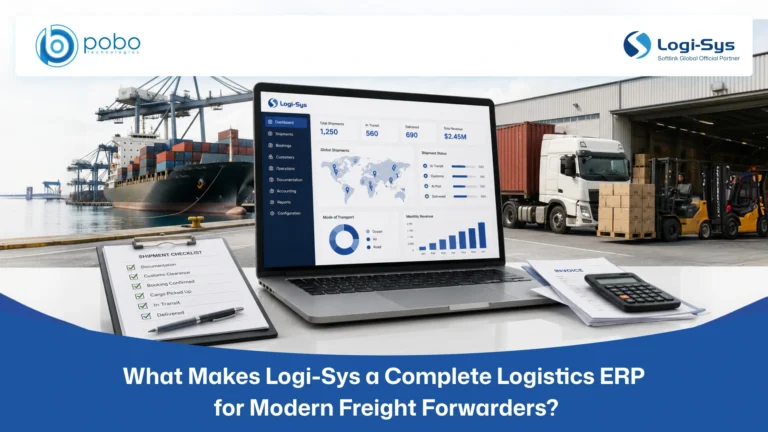
Logi-Sys is an integrated cloud-based logistics ERP platform that offers connected solutions for freight forwarding, customs compliance, warehousing, transportation, invoicing, financial accounting, and more. Its broad range of modules and features enables logistics companies to manage their operations from customer inquiry and quotation through shipment execution, delivery, billing, and financial closure.
The platform provides shipment visibility, workflow automation, document processing, customer portals, and reporting capabilities. These features make Logi-Sys a valuable platform for logistics companies looking to reduce repetitive work, manage complex processes, and make informed operational and financial decisions.
Industries that Logi-Sys Serves
Logi-Sys supports a wide range of businesses operating across freight, logistics, customs, transportation, warehousing, and supply chain services. Freight forwarders, customs brokers, NVOCCs, consolidators, third-party logistics providers, transportation companies, warehouse operators, and CFS or AFS operators can use Logi-Sys to simplify daily operations, manage complex workflows, and maintain greater control.
The platform’s modular design allows businesses to configure the capabilities that suit their services. A freight forwarder may focus on bookings, documentation, consolidations, carrier connectivity, shipment tracking, invoicing, and profitability. A customs broker may prioritize declarations, regulatory documentation, customs communication, and clearance workflows.
One of the key advantages of Logi-Sys ERP is its support for inbound and outbound logistics. The platform helps businesses keep shipment, customer, document, charge, and financial information connected while maintaining better visibility across departments.
Understanding the Role of a Logi-Sys Service Partner
A Logi-Sys service partner is a specialized logistics technology company authorized by Softlink Global to implement, configure, customize, integrate, and support the Logi-Sys cloud ERP platform for freight forwarders, customs brokers, warehouse operators, transport companies, and other logistics service providers.
In simple terms, Logi-Sys provides the ERP capabilities, while the service partner helps the business apply those capabilities correctly in its daily operations.
Through the service partner, organizations can receive assistance throughout the implementation process, obtain solutions configured around their operational needs, connect third-party systems, and receive continuous guidance and training for users.
What are the Advantages of Working with a Logi-Sys Service Partner?
Working with a Logi-Sys service partner gives businesses access to the technical knowledge and logistics experience needed to use the platform effectively. The right partner can support implementation, customization, training, integration, and ongoing system improvements.
Improving Implementation and Customization
Logi-Sys service partners understand the platform and help configure it according to the individual requirements of each business. They collaborate with clients to understand their workflows, processes, responsibilities, and objectives before aligning the system with the organization’s goals.
Based on these requirements, the partner can configure modules, milestones, user permissions, approval levels, charge codes, billing rules, documents, and reports. When a genuine requirement cannot be addressed through standard configuration, the partner can also support controlled customization.
Through effective implementation and customization, logistics companies can simplify operations, reduce repeated data entry, improve accuracy, and achieve better results from Logi-Sys ERP.
Continuous Support and Training
Another benefit of working with a Logi-Sys service partner is access to ongoing support and training. Service partners can provide structured training programs that teach users how to work with Logi-Sys correctly.
They provide role-based guidance for operations, customs, transportation, warehousing, billing, accounting, and management users. They can also explain recommended practices and help resolve system, configuration, workflow, and user-related issues.
Continuous support and training help ensure that employees have the knowledge and confidence required to use Logi-Sys effectively. This also reduces the likelihood of users returning to spreadsheets, emails, and manual workarounds.
Access to Industry Insights and Expert Advice
Logi-Sys service partners are logistics and supply chain technology specialists with an understanding of freight operations, customs processes, transportation, warehousing, billing, and accounting.
By working with a service partner, businesses gain access to practical insights and guidance that can help them make informed decisions. Partners can provide recommendations on workflow improvements, data quality, billing controls, user responsibilities, system configuration, and operational reporting.
This combination of industry knowledge and product expertise helps organizations resolve the underlying cause of operational issues, improve efficiency, and make better use of Logi-Sys ERP.
Smooth Integration and System Improvements
Logi-Sys service partners ensure that the ERP integrates smoothly with the organization’s existing systems and operations. They work closely with internal IT teams and third-party providers to reduce disruption and support a seamless transition to the new platform.
Depending on the company’s requirements, Logi-Sys may need to connect with customs applications, financial systems, carrier platforms, customer portals, banks, CRMs, and other third-party solutions. A service partner can support technical assessment, data mapping, configuration, testing, validation, and error handling.
Furthermore, service partners stay up to date with the latest Logi-Sys features and enhancements, helping organizations access and adopt relevant capabilities as their operational requirements evolve.
Conclusion
Working with a Logi-Sys service partner is important for businesses seeking to realize the full benefits of Logi-Sys ERP. From improved implementation and customization to continuous support and training, service partners help organizations optimize logistics operations and achieve greater efficiency.
Businesses that choose the right service partner can streamline their processes, improve productivity, strengthen data accuracy, and remain prepared for changing operational requirements.
If you are considering implementing Logi-Sys or want to improve your existing ERP environment, working with an experienced service partner can help you realize its full potential.
Contact POBO Technologies, an official Softlink Global partner, to discuss how we can support your Logi-Sys implementation, integration, customization, training, and ongoing optimization.